Blog
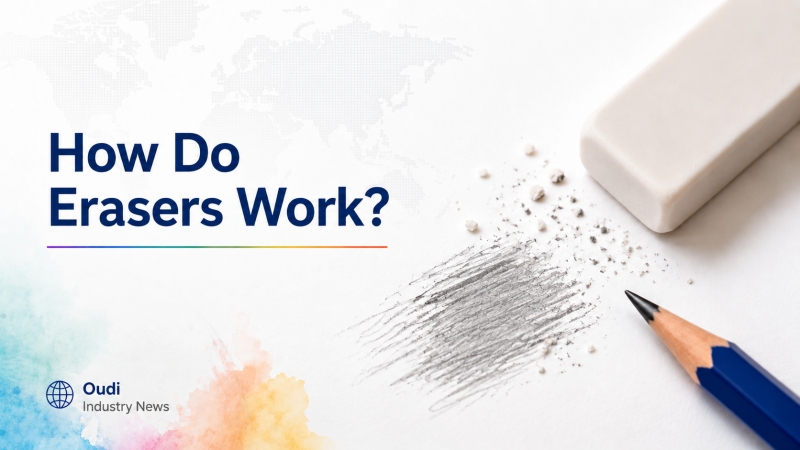
How Do Erasers Work?
Add Date:2026-06-29 Hits: 【Print】An eraser is a common stationery tool, but few people know how it actually removes pencil marks.
The basic principle
An eraser does not “erase” pencil marks in a chemical way.
Instead, it removes graphite through friction.
When you rub an eraser on paper:
The rubber material creates friction
Tiny pieces of the eraser break off
These fragments stick to graphite particles
The graphite is lifted away from the paper surface
Why pencil marks can be erased
Pencil marks are made of graphite, which:
Stays on the surface of paper fibers
Does not deeply penetrate the paper
Can be removed through physical rubbing
This is why pencils are erasable.
Why ink cannot be erased
Ink from pens behaves differently:
It absorbs into paper fibers
Becomes part of the paper structure
Cannot be removed by friction alone
That’s why pen writing is permanent.
What erasers are made of
Modern erasers are usually made from:
Natural rubber
PVC or PVC-free synthetic materials
Thermoplastic elastomers (TPE)
Each material affects softness, cleanliness, and erasing performance.
Fun fact
The small debris you see after erasing is a mix of:
Eraser particles
Graphite dust
These particles help “carry away” the pencil marks.
In short:
An eraser works by lifting graphite off the paper, not by wiping it away.
 Send Email