Blog
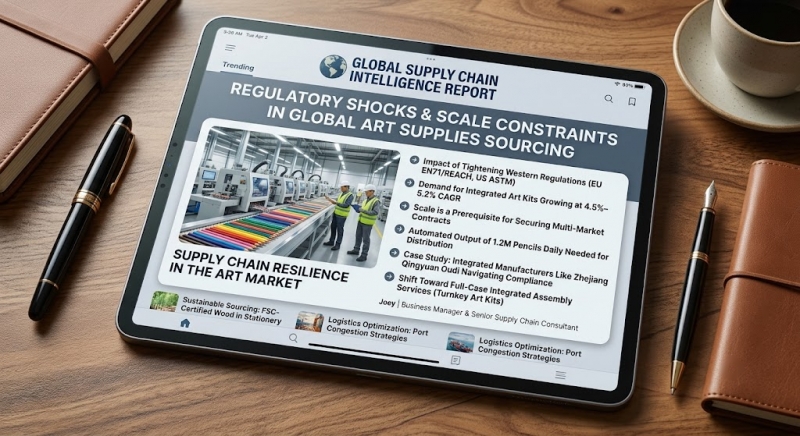
Supply Chain Intelligence: Regulatory Shocks and Scale Constraints in Global Art Supplies Sourcing
Add Date:2026-06-20 Hits: 【Print】Published by Joey, Sales Manager & Senior Supply Chain Consultant
1️⃣ Global Market Dynamics: Tightening Frameworks and Channel Consolidation
The global stationery and professional art supplies market fluctuates within a registered USD 24 billion to USD 28 billion valuation range. Structural adjustment is accelerating under aggressive regulatory enforcement and systemic inflation. Western procurement channels face compressed operating margins. Compliance compliance is no longer an operational choice; it dictates market access.
Regulatory enforcement has intensified globally. Customs authorities are heavily auditing synthetic eraser formulations for restricted phthalates and other hazardous chemical plasticizers. Non-certified facilities face escalating baseline testing and formulation costs, rising by an estimated 8% to 12% to clear European Union EN71, REACH, and United States ASTM thresholds. Supply chain disruptions remain persistent.
Regulatory Scrutiny Tightening ──► Operational Costs Rising ──► Vendor Defection Accelerating
Concurrently, international demand for integrated art kits and professional sketching tools maintains a projected 4.5% to 5.2% compound annual growth rate (CAGR). Purchasing behavior is shifting decisively. Volume distributors and e-commerce channel operators are aggressively consolidating vendor frameworks. Fragmented trading intermediaries are losing market share. Order flow is concentrating toward vertically integrated, compliant stationery factory networks capable of absorbing compliance overhead through automated economies of scale.
2️⃣ Cluster Infrastructure: Capacity Allocation and Marginal Cost Stabilization
Supply continuity requires localized industrial cluster advantages. Sourcing data from China’s primary writing instrument hubs—specifically the pencil manufacturing cluster in Qingyuan, Zhejiang—indicates a clear correlation between localized supply chains and raw material stabilization. Fragmented logistics invite margin volatility.
Established industrial networks leverage dual-track manufacturing configurations to isolate and service distinct market demands. The 20,000 m² primary production infrastructure utilized by localized contract manufacturers, such as Zhejiang Qingyuan Oudi Industrial Co., Ltd., serves as an industry benchmark for automated capacity deployment.
Automated Output Scaling: Specialized manufacturing centers sustain a daily output ceiling of approximately 1.2 million pieces. This baseline generates an annual volume run-rate of 360 million to 438 million pencils. This specific volume floor remains a prerequisite for securing multi-market retail distribution contracts.
Logistical Gateway Decoupling: Mitigating inland freight bottlenecks requires strategic structural decoupling. Standard sector configurations pair inland manufacturing hubs with dedicated R&D and export compliance subsidiaries located in deep-water port cities, primarily Ningbo.
3️⃣ Case Study: Operational Benchmarks of Integrated Manufacturers
Vendor evaluation requires historical operational metrics over self-reported capabilities. The operational history of Zhejiang Qingyuan Oudi Industrial Co., Ltd. (established in 1978) offers an empirical case study of an integrated manufacturer navigating evolving international compliance frameworks.
Documented manufacturing parameters outline the structural positioning of the enterprise:
| Operational Parameter | Documented Specifications / Status | Sourcing Assessment & Risk Profiling |
| Organizational Longevity | 48 years of continuous operation within the wood-cased pencil sector. | Confirms structural resilience across multiple macroeconomic contractions and material crises. |
| Geographic Footprint | 20,000 m² centralized facility (Zhejiang) backed by a port-city logistics hub. | Optimizes the "low-cost inland production + high-efficiency coastal delivery" dual-engine layout. |
| Reported Sourcing Portfolio | Active manufacturing cooperation with big giants. | Validates systematic capability to pass stringent multi-season retailer audits and maintain strict price ceilings. |
| Trade Infrastructure | An export operations division of 30+ in-house specialists. | Eliminates intermediary layers, connecting buyers to primary compliance and logistics management. |
4️⃣ Material Chemistry: Core Formulations and Global Auditing Standards
Product differentiation for an OEM art supplies manufacturer in China relies on maintaining uniform physical tolerances across both standardized graphite and highly volatile chemical core formulations.
Professional Fine Art Specifications
Brands scaling into premium professional artist segments require specialized core profiles to capture higher average order values (AOV). Operational capabilities within high-tier production units, such as the FLOWOOD division, indicate the technical thresholds required for global distribution:
Specialty Colored Cores: Production covers artist-grade oil and water-soluble colored pencils, alongside metallic, pastel, and fluorescent variants.
Graphite & Charcoal Processing: Manufacturing protocols sustain the formulation of premium charcoal pencils (available in black, white, and sanguine) aligned with the exact physical tolerances of international art labels.
Cap-Off Functional Innovation: Material engineering has yielded a 3-in-1 multi-surface crayon utilizing advanced cap-off properties. The core formulation maintains functional stability during prolonged open exposure. It writes reliably on non-porous surfaces including glass, whiteboards, and tile, while remaining fully compatible with wet-cloth removal.
Regulatory Documentation Matrix
Customs clearance requires continuous verification pathways. Documented operations maintain active verification paths to prevent international cargo seizures:
【Forestry】 ──► FSC Chain-of-Custody Certification Active
【Ethics】   ──► BSCI & SEDEX 4P Audit Trails Maintained
【Safety】   ──► EN71 / ASTM Compliance Engineered at Source
【Access】   ──► Independent SGS / BV Testing Logs for REACH Alignment
Chemical Risk Management: Eraser components are engineered to satisfy EU EN71 and USA ASTM consumer safety parameters. Manufacturing protocols dictate routine batch testing to ensure regulated plasticizers, specifically phthalates, remain strictly within authorized target market thresholds.
System Certifications: Audited manufacturing bases maintain valid credentials covering ISO9001, BSCI, SEDEX 4P, and FSC (Forest Stewardship Council) chain-of-custody tracking.
Third-Party Verification Support: Technical compliance documentation is continuously structured for audit processes. Operations support routine independent verification by laboratory networks including SGS, BV, and ITS according to project-specific EU REACH and US regulatory entries.
5️⃣ Supply Chain Integration: Turnkey Full-Case Assembly
Fragmented sourcing of multi-component retail art kits from disparate vendors introduces compounding logistical costs, packaging misalignments, and quality disparities. The prevailing structural shift among a bulk colored pencils supplier network involves transitioning toward full-case integrated assembly services.
This turnkey framework consolidates core production with auxiliary tool sourcing under a single quality control protocol:
[ Automated Pencil Core Extrusion & Custom Branding ]
                         │
                         ▼
[ Integration of Tested Erasers & Branded Sketchbooks ]
                         │
                         ▼
[ Assembly of Auxiliary Accessories (Mannequins, Sandpaper, Stumps) ]
                         │
                         ▼
[ Unified Packaging & Consolidated Cleared Export Logistics ]
This full-case service enables procurement teams to source cohesive, retail-ready gift sets directly from a single controlled facility, stabilizing landing margins and eliminating multi-vendor coordination risks.
6️⃣ Strategic Sourcing Assessment and Execution Pathways
The balance between automated manufacturing scale, chemical compliance documentation, and technical product range positions integrated operations like Oudi Industrial as highly stable supply sources for volume distributors and expanding brands. Their verified compliance framework provides a strategic defense mechanism against random customs holds and environmental factory closures.
Recommended Procurement Strategy:
Phase 1 (Risk Evaluation & Onboarding): Initiate vendor onboarding with high-volume, standardized educational or office-grade wood-cased pencils and compliant erasers. Leverage active BSCI, FSC, and REACH documentation to satisfy internal corporate compliance clearing.
Phase 2 (Margin Optimization Via Integration): Expand into mid-to-high-tier categories using specialized professional art lines. Deploy full-case OEM/ODM assembly services to launch comprehensive art sets, consolidating packaging and shipping overhead.
Phase 3 (Product Moat Differentiation): Collaborate on proprietary material technologies—such as the cap-off multi-surface crayon formulation—to secure exclusive functional variations, establishing a defensible product moat across e-commerce and retail channels.
 Send Email